


Dr Heidi Wechtler
Newcastle Business School, University of Newcastle
3MT Training

Mastering the Three-Minute Thesis for Cooperative Scholars
Founded by the University of Queensland in 2008, 3MT is now a vast competition that spans more than 80 countries and 900 universities worldwide. Since its inception (minus a few years online during the Covid-19 period), the 3-Minute Thesis has been held as a live performance. But what is it about?
WHAT
They say that, on average, it would take nine hours to present an eighty-thousand-word thesis to an audience.
Here, the competitors have three minutes.
The Three-Minute Thesis competition is held annually between MPhil and PhD candidates at a university-wide and Asia-Pacific level. In just three minutes, using only a single PowerPoint slide, participants present their research to a non-specialist audience – what they’re doing, how they’re doing it, and why.
WHY
The Three Minute Thesis is not only a presentation exercise; it is a way of building the ability to pitch an idea with clarity, precision, and impact. As researchers move through their careers, they increasingly find themselves surrounded by capable peers, each working on projects that are rigorous and meaningful. In this environment, technical brilliance alone is not enough to ensure recognition or influence. What often makes the difference is the capacity to explain why a project matters—succinctly, persuasively, and in terms that can be understood by people outside the immediate field.
The 3MT develops exactly this skill: distilling complex ideas without losing their core significance. It helps researchers step beyond specialist language and speak in ways that engage decision-makers, industry leaders, and the wider community. This is not a secondary skill but a central one, because the ability to communicate research well is closely tied to securing funding, creating collaborations, and making a wider impact. In other words, the 3MT is not only about what your research is but also why it should be noticed, supported, and remembered.
HOW
The Three Minute Thesis is a short, accessible talk supported by a single slide, delivered without notes, and using little text. The goal is to explain your research to an audience outside your field, combining the what (the core elements), the why (the research problem/why it matters), the how (how you are tackling it), and the so what (the difference it can make, what is it to take here from a practitioner's point of view). It is about making your work clear, memorable, and meaningful to people who may not share your expertise but whose understanding and support are essential.

Activities
Exercise 1. Speech Content
Exercise 2. Script Check
Exercise 3. Matching the Judging Criteria

Common Mistakes
Timing
One of the most frequent mistakes is timing. If you go over three minutes, you are automatically disqualified. But being too short is also a lost opportunity. Every second you do not use is time someone else will take to promote their work more effectively. You do not need to aim for an exact three minutes—very few people can manage that perfectly—but you should target between 2.50 and 3 minutes. That way, you stay within the rules while also making full use of the time available.
The Blank moment
A second issue is over-reliance on memorization. Many participants learn their text by heart, which is natural. But if the script is too complex, written in a style that is not really your own, or packed with academic language, stress can easily cause a blank moment on stage. Almost every competition has at least one participant who loses their text completely. If that happens, do not panic: you can ask for a redo, just for the sake of sharing your project, even if you are disqualified. The best way to avoid this risk is to write your talk in the way you naturally speak. Imagine explaining your research aloud to a friend, then write down those sentences. What you end up learning is not an artificial script but your own words, which are much easier to recall under pressure.
Content balance
A third common problem is content balance. Too often, students spend most of their time describing the background of the project. While passion for the subject is important, the audience needs to hear more than context. They want to know what you will actually do and why it matters to them. Imagine there are investors in the audience. If they were to fund your project, what return on investment would they get? This framing helps you shift from explaining what excites you personally to explaining what your research can contribute to others.
A Picture is Worth a Thousand Words...
A fourth common mistake concerns the relationship between the image and the spoken content. Experience shows that only a very small amount of text is necessary on a 3MT slide. The audience cannot both read a content-packed slide and listen to a fast-paced speech; if they are busy reading, they will stop listening to you. This is why the image becomes so important. It should be memorable, striking, or even amusing—something that triggers emotion, whether surprise, concern, joy, or relief. Some presenters use a simple process illustration (with icons rather than words), a cartoon-style representation of their topic, or a single evocative picture of a person or place. If you decide to use AI-generated images, be mindful of the risk of “AI fatigue.” Distinguish yourself with a strong, consistent style so that your visual supports the message rather than distracting from it.
Some examples (various styles)


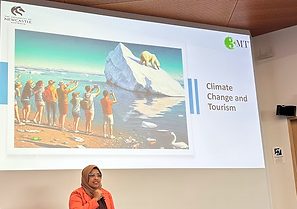


Past Winners
Newcastle Business School Winner - 2025
Alex Gibson - Sport Management

Newcastle Business School Winner - 2024
Stefano Bruzzo - Health Economics


The Art of Presenting
We are not all equal when it comes to public speaking. Some people feel shy or anxious in front of an audience, while others thrive on sharing their ideas and draw energy from the crowd. For many, presenting in English adds another layer of difficulty. Certain words can feel hard to pronounce, and the effort of expressing yourself in a second language can be draining.
Like most skills, there is no miracle solution—only practice. The ability to speak clearly and confidently improves with time, preparation, and feedback. If you feel that you underperform when presenting, consider investing in this skill. A few hours of focused coaching can make a remarkable difference in how you communicate, how you are perceived, and how much you enjoy the experience.
At Newcastle Business School, several HDR students have worked with a professional coach for their confirmation seminar, 3MT, or final defense. The sessions are not free, but the results often justify the investment. If you can afford it, working with a coach may be one of the best ways to strengthen your presence and confidence as a researcher.
We are pleased to recommend Thomas Riviello, founder of Riviello Academic Advisory (RAA), who has worked extensively with our HDR cohort. A former headhunter based in the United States, Thomas brings over fifteen years of experience in academic and professional communication. He has supported numerous doctoral candidates in navigating difficult confirmation scenarios, including cases requiring a redo, candidates experiencing high anxiety, and individuals whose strong accents posed initial challenges to audience engagement.
Meet Riviello Academic Advisory (RAA)
Name: Thomas Riviello
Business Name: Riviello Academic Advisory (RAA)
Contact Information:
-
Email: contacttraa@gmail.com
-
Phone: +1-512-954-3883
-
WhatsApp: +1-512-954-3883
Get started today:
-
Schedule a Free Consultation to discuss your needs and see how I can support your success.
-
Download My Free Guide to mastering the PhD confirmation process and job interviews.
